Why SSL Alone Doesn't Secure a Website (and Never Has)
Introduction
For years, website security conversations have been reduced to a single checkbox: "Do you have SSL?" The presence of HTTPS has become shorthand for trust, safety, and compliance -- to the point where many businesses believe an SSL certificate is the primary line of defence against cyber threats.
That belief is wrong.
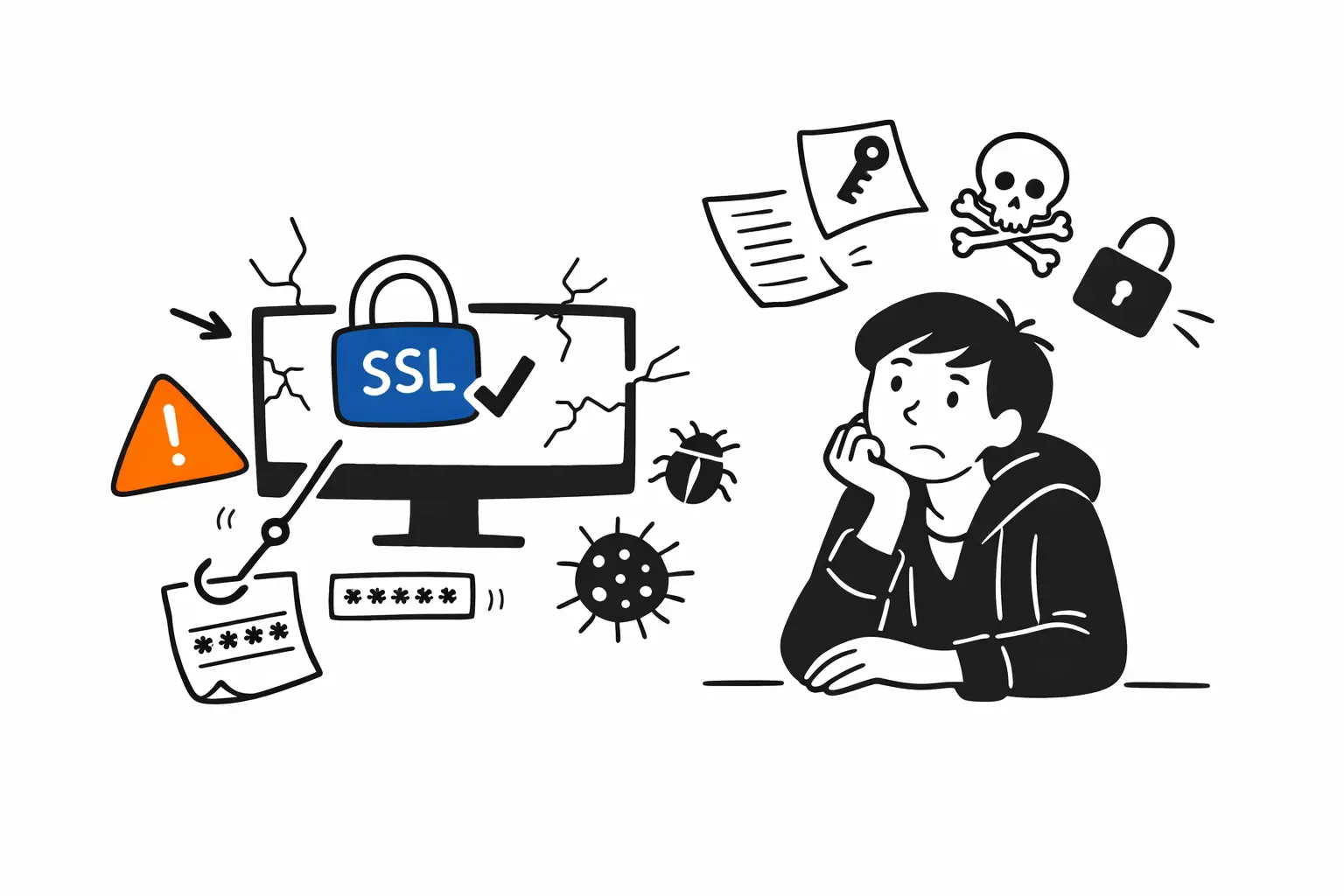
SSL was never designed to secure websites from attacks. It was designed to protect data in transit, not to prevent compromise, fraud, or abuse. While SSL is essential, treating it as a security solution creates a dangerous false sense of protection.
This article explains what SSL actually does, why it doesn't stop modern attacks, and how this misconception continues to put websites at risk.
What SSL Actually Does (and What It Never Did)
SSL (now technically TLS) provides:
- Encryption of data exchanged between a user and a server
- Integrity of transmitted data
- Authentication of the server's identity
That's it.
SSL ensures that data cannot be easily intercepted or altered in transit. It does not:
- Validate whether a website is safe
- Inspect traffic for malicious payloads
- Prevent unauthorized access
- Detect vulnerabilities or malware
The padlock icon indicates encrypted communication -- not a secure application.
How SSL Became a Security Myth
Browser Messaging and Visual Cues
Modern browsers heavily promote HTTPS:
- "Not Secure" warnings for HTTP sites
- Green padlocks and trust indicators
- SEO ranking incentives for HTTPS
While these changes improved encryption adoption, they also blurred the line between privacy and security in the public's mind.
Compliance Shortcuts
Some compliance frameworks reference encryption requirements, which businesses misinterpret as "SSL equals compliant." This leads to minimal security investment beyond certificate installation.
The result is compliance theatre -- appearing secure without addressing real risk.
The Reality of Attacks on HTTPS Websites
Nearly all malicious websites today use HTTPS. Attackers:
- Obtain free SSL certificates
- Encrypt phishing pages
- Hide malware delivery inside encrypted traffic
Encryption protects attackers just as effectively as it protects legitimate users.
SSL does nothing to stop:
- SQL injection
- Cross-site scripting (XSS)
- Credential stuffing
- Brute-force attacks
- File inclusion vulnerabilities
- Business logic abuse
In many cases, encryption actually prevents basic network inspection, allowing malicious traffic to pass unnoticed.
Why SSL Fails as a Defensive Control
No Traffic Inspection
SSL encrypts payloads. Without additional controls:
- Malicious requests remain hidden
- Web servers process harmful input blindly
- Detection happens too late -- if at all
This is why modern security architectures terminate SSL at inspection points, such as WAFs, before forwarding traffic.
No Authentication Beyond the Server
SSL verifies the server's identity -- not the user's intent.
It cannot determine whether:
- A login attempt is legitimate
- An API call is abusive
- A request is automated
- A user is attempting fraud
These are application-level problems that SSL was never meant to solve.
The SSL + "Secure Hosting" Fallacy
Many businesses assume SSL combined with "secure hosting" is sufficient. In reality:
- Hosting providers protect infrastructure, not applications
- Shared responsibility models shift risk to site owners
- Default protections are generic and reactive
SSL does nothing to bridge this gap.
Where SSL Fits in a Real Security Model
SSL is a baseline requirement, not a solution.
It should sit alongside:
- Web application firewalls
- Authentication and access controls
- Continuous monitoring
- Patch and update management
- Secure development practices
Without these layers, SSL only ensures that attackers reach your website securely.
Common Scenarios Where SSL Fails Completely
Phishing and Fraud
Encrypted phishing sites look legitimate. SSL reassures users while attackers steal credentials.
Credential Stuffing
Attackers use encrypted connections to automate login attempts at scale.
Vulnerable Plugins and CMS Exploits
SSL happily encrypts exploit payloads targeting known vulnerabilities.
API Abuse
Encrypted API endpoints remain fully exposed without rate limiting or validation.
Why This Misconception Persists
The belief that SSL equals security persists because:
- It's simple and visible
- It's easy to explain to non-technical stakeholders
- It provides a false sense of completion
Security that can be "checked off" feels comforting -- even when it's ineffective.
Rethinking Website Security Beyond SSL
Real website security focuses on:
- Preventing abuse, not just protecting privacy
- Detecting malicious behavior, not just encrypting it
- Reducing attack surface, not just hiding it
SSL supports these goals -- but only as one small piece of a broader security posture.
Final Thoughts
SSL is essential. But it has never secured websites on its own -- and it never will.
Treating SSL as a security solution leaves websites exposed to modern attacks that operate entirely within encrypted traffic. True security requires layered controls, visibility into behavior, and continuous oversight.
The padlock means your data is private. It does not mean your website is safe.